Wednesday, April 18, 2012

From Cows to Hormones to Cheap Food

From Cows to Hormones to Cheap Food:

It All Comes Full Circle

By: Katrina Pioli

A jersey cow and I at the U of I Research Dairy Farm

Working at the University of Illinois Research Dairy Farm has incredible upsides as an animal science major.  I started two years ago having no experience with large animals, now dairy cows have become one of my favorite animals to be around.  I have learned and gotten so much hands on experience these past two years.  These experiences include helping give birth to a calf, seeing hooves being trimmed, watching a surgery to untwist the abomasum (which is apart of the cow’s stomach), and in particular feeling a super ovulated ovary. A super ovulated ovary in basic terms is an ovary that is over stimulated by hormones to maximize the number of eggs that it can produce in one cycle. 

A couple months ago, my boss at the dairy farm told me a veterinarian was coming to collect ovarian eggs from two brown swiss cows we milk at the farm.  This process is called flushing.  I immediately became excited because I had never seen this process before.  Skipping part of my lunch break, I watched the veterinarian put a tube in the fallopian tube that leads to the ovary. He then used chemically treated water to expand and contract the ovary in order to try to irritate the follicles enough to release the eggs inside them.  The water will then carry the eggs out in the tube to a container that I was holding at the time.  After this process was done, the veterinarian invited me to feel the ovaries of the cow.  The little bumps I was feeling were ruptured follicles.  After this whole entire process, I could not help but ponder about how these follicles on the ovaries flourish.  At the time, I knew hormones were apart of this process. But how are these hormones made?  How do they make follicles? What are these mechanisms?  I was diving headfirst into answering these questions.
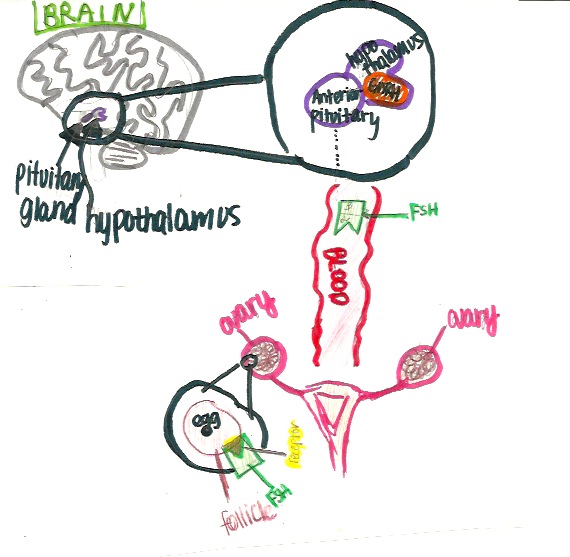
Preview of process
In order to get to the final product of follicles on ovaries, I had to start from the very beginning.  I found that all the hormones that are involved in this process are called gonadotropins or glycoproteins, but what are glycoproteins exactly?  Where do they come from?  The major glycoprotein that is involved in follicular development is called follicular stimulating hormone.  The hormones are produced in the anterior pituitary.  Just in case you do not know, the anterior pituitary is part of the pituitary gland and is a very influential gland of the body. It controls different hormones to regulate organs and practically the whole body system in general.  How are these specific hormones made?
Well, I had to go back even further in the process.  Follicular stimulating hormone consists of an alpha subunit and a specific beta subunit.  The alpha subunit is the same in other hormones, and the beta subunit is a unique part of the follicular stimulating hormone.  What is the “alpha subunit” exactly?  I found that it was not as complicated as it sounded.  The alpha subunit is basically a sequence of amino acids.  Amino acids are the building blocks for proteins.  Amino acids will have a carboxylic acid group, amino group, and unique side chain.  Therefore, the alpha subunit is just a protein that is encoded by the gene chorionic gonadotropin alpha.  Recall from your basic physiology class that genes encode for proteins so this makes sense!  The beta subunit contains a longer amino acid sequence.  To complete the structures of these hormones, n-linked glycosylation must occur, but yet another question comes up.  What exactly is glycosylation?  In short, glycosylation is the process of attaching the carbohydrate to the protein.  N-linked glycosylation is where the carbohydrate attacks the nitrogen on a specific amino acid in the protein.  In the case of FSH, a carbohydrate will attach to asparagine’s side chain, which is an amino group (nitrogen).  So now we know how FSH is made, but what causes it to release from the anterior pituitary?
GnRH
The hypothalamus is one of the ways the glycoprotein hormones are regulated.  The hypothalamus will release GnRH.  GnRH, or gonadotropin-releasing hormone, consists of ten peptides, secreted from the hypothalamus, and travels to the anterior pituitary in a pulse like pattern. Above is a picture of GnRH.  The pulse like pattern in which GnRH is secreted can be contributed to the relatively consistent cycle, the menstrual cycle, that female mammals experience after reaching puberty.  Therefore GnRH controls the menstrual cycle.
It seemed important to know that the release of follicular stimulating hormone (FSH) depends on the frequency and amplitude of the pulses of GnRH.  GnRH will regulate the transcription, or synthesis, of the gene that we just learned about above (chorionic gonadotropin alpha) based on the pulses.  Low frequency of GnRH will increase the transcription of chorionic gonadotropin alpha and beta. This process then produces FSH in the anterior pituitary. 
When FSH is secreted, it will travel in the blood and attach to its receptor on the ovary to create follicles. Before moving on to what happens when FSH binds to its receptor on the ovary, I needed to know more about the receptor itself.  The main FSH receptor has a high affinity for FSH, which means the hormone is very attracted to its receptor. The receptor is found on the membrane of granulosa cells, which are the cells that make up the follicle.  The FSH receptor is part of a family called the G protein-coupled receptors that situate themselves in the membrane; therefore called a transmembrane receptor.  In general terms, the receptor will sense familiar molecules and then do the appropriate signaling inside the cell.  One part of the FSH receptor is hydrophobic which means it does not dissolve in water.  This is obvious since the cell membrane is made up of a phospholipid bilayer that has a hydrophobic tails inside; therefore part of the receptor must be hydrophobic in order for it to be a transmembrane protein.  The other part of the FSH receptor is the extracellular domain.  This domain is very important because it is where the hormone binds.
Finally, FSH binds to its receptor. Then what happens? The next steps are a cascade of events.    The hormone and receptor will change conformation to make it active.  The Gs alpha subunit, which is a protein on the receptor, can now leave and signal adenylyl cyclase within the cell, or follicle.   Adenylyl cyclase will then convert ATP (which is where we get our energy!) into cAMP.  This pathway is shown below.  It is done by removing two phosphate groups and making a ring out the phosphate still attached to the rest of the molecule.  cAMP is used on an inside the cell to signal a specific reaction.   Because of the synthesis of cAMP in the follicle, protein kinase A is activated.  Protein kinase A is an enzyme.  It has two regulatory and two catalytic subunits.  When there is an increase of cAMP, the enzyme is activated and breaks part the catalytic subunits from the regulatory subunits. Transcription factors will then be activated because of this, and mRNA transcription begins in the cell.

That seems like a whole bunch of mumbo jumbo, right?  The activation of mRNA transcription is essentially the end of the process in which FSH has an effect on the ovary.  What happens?  What we are leading up to is the synthesis and growth of the follicle on the ovary.  FSH will cause the granulosa cells to grow and multiply.  The growth of the granulosa cells will cause a follicle to become bigger. As you are probably fully aware, the follicle will contain an egg.  When the follicle is fully mature, it will rupture at a particular time in the cycle where the egg will be release and have a fate of being fertilized or not.
Coming full circle, as I felt the brown swiss cow’s ovaries, I had no idea how complex the mechanism of FSH was on those super ovulatory follicles I was feeling.  I could not imagine how much cooler animal science could get.  All I knew was there was one hormone that was partly responsible for the excitement I received that day.  But really it was not just that one hormone.  It was the organic chemistry in and of itself.
One thing I wanted to end on is why should you care?  The process of super ovulating ovaries (increasing the amount of FSH to increase follicle production) is not a new phenomenon, and it is practiced widely today.  This process is so important because we can increase the amount of good eggs, which increases chances of pregnancy in production animals, which in turn increases efficiency.  The United States is a consumer society.  We have cheap food so we can afford to buy other things.  Increasing conception rate for production animals allows for maximum efficiency for that animal. Maximum  efficiency means less input to the animal which gives us cheap food. For humans, it gives women the ability to increase their chances of pregnancy, freeze her eggs for a later date, or donate to a woman who has infertile eggs.  These are just some ways super ovulating and the mechanism of FSH on an ovary is important to today’s society and why it is so exciting to me.

Below is a Jmol of FSH and its corresponding receptor 

Resources
Bernard, Daniel, et. al. 2010. Mechanisms of FSH synthesis: what we know, what we don’t, and why we should care. Fertility and Sterility 93: 2465: 2485.
Simoni, Manuela, et. al. 1997. Follicle Stimulation Hormone Receptor: Biochemistry, Molecular Biology, Physiology, Pathophysiology. Endocrine Reviews 18: 739-773.
Bousifield, George and Diaz, James. 2011. Synthesis and Secretion of Gonadotropins including structure function correlates. Review Endocrine Metabolism Disorders 12: 289-302.

The Diet Ingredient That is Making You Gain Weight

More and more I have been hearing people say that diet soda is bad for you; however, no one ever really gives a reason why diet soda is bad. Like most people, I assume that if something is classified as “diet”, it must be good, or at least better, for you. For that reason, when I drink soda, I always choose the diet version. Therefore, I decided to search for the answer to the question: “What ingredient in diet soda is ‘bad’ for you?”.


I started my search by simply typing “why is diet soda bad for you” into Google. After scanning through several results that came up, I found an article from TIME.com entitled “Can Sugar Substitutes Make You Fat?”. This article briefly touches on a series of experiments conducted at Purdue University which found that rats whose diet contained saccharin, a zero calorie sweetener found in many diet soda brands, gained more weight than rats whose diet contained glucose, a natural, high calorie sweetener. The article then gives a brief explanation for why this happens using data from another study conducted at Purdue University. It explains that animals are conditioned to anticipate a lot of calories when consuming a sweetened food or drink. Therefore, when they do not receive the calories they anticipated, they will intake additional calories to compensate for the phantom calories. This article essentially answered the question I wanted answered; however, I wanted to know more details about the vaguely explained experiments that revealed this data. Furthermore, this article prompted me to ask a second question: “How does this ingredient cause weight gain?”.


I decided to look for the primary literature for the experiments that the article on TIME.com mentioned. I did a Google search for the first experiment conducted at Purdue University and found a link which lead me to an article published in the journal Appetite entitled “Body Weight Gain in Rats Consuming Sweetened Liquids: Effects of Caffeine and Diet Composition”. This journal article goes into detail about two experiments conducted to see the effects zero calorie sweeteners, such as saccharin, and natural, high calorie sweeteners, such as glucose, have on weight gain. In addition, this article explains the effect saccharin and glucose have on weight gain when caffeine is added; however, the effects of caffeine and the experiments involving caffeine will not be described in this post. The structures of D-glucose, C6H12O6, and saccharin, C7H5NO3S, are shown in the two Jmols below, respectively.


Figure 1
In the first experiment, 49 naive, adult male Spague-Dawley rats were split up into four groups according to their body weight. All four groups were given 50g of a flavored, sweetened liquid for 3 hours per day for 14 days. While the liquid was available, the chow was removed and then immediately put back once the 3 hours were up. The chow given to all four groups was the standard, low fat lab diet. Two of the groups received liquid that was sweetened with 10% glucose, while the other two groups received liquid that was sweetened with 0.3% saccharin. The amount of liquid and chow taken in was measured daily. Also, the body weight was measured daily by weighing the rats. The results of this first experiment are summarized in Figure 1. The rats given access to liquid that was sweetened with 0.3% saccharin gained significantly more weight than the rats given access to liquid that was sweetened with 10% glucose. Also, the amount of calories consumed by the rats given access to liquid sweetened with 0.3% saccharin was significantly more than the amount of calories consumed by the rats given access to liquid sweetened by 10% glucose. The increased number of calories consumed by the rats given access to saccharin sweetened liquid accounts for the increased weight gain by these rats.


Figure 2
For the second experiment, the effects of saccharin and glucose on weight gain were accessed under dietary conditions similar to a “Westernized” diet high in fat and sugar. Thirty-three naive, male Sprague-Dawley rats were given one week to acclimate to the standard lab chow which was then followed by a week to acclimate to a powdered, unsweetened, high fat diet. After these two weeks, the rats were split into four groups and began to receive access to 30g of sweetened liquid daily for six days a week for four weeks. On the seventh day of each week, each group was given only water and the high fat chow. As with the first experiment, two groups received liquid that was sweetened with 20% glucose, while the other two groups received liquid that was sweetened with 0.3% saccharin. The amount of liquid taken in daily was measured, and body weight was measured daily by weighing the rats; however, unlike the first experiment, the amount of food taken in daily could not be measured because the chow used in this experiment was a powder and was often spilt in the cages that housed the rats. The results of this second experiment are summarized in Figure 2. The rats given access to liquid that was sweetened with 0.3% saccharin gained significantly more weight than the rats given access to liquid that was sweetened with 20% glucose. In addition, the amount of saccharin-sweetened liquid consumed was more than the amount of glucose-sweetened liquid. The increased amount of sweetened liquid consumed by the rats given access to saccharin sweetened liquid accounts for the increased weight gain by these rats. Overall, the results of these two experiments show that consuming liquids that contain a zero calorie sweetener, such as saccharin, causes an increase in weight gain and food intake in rats in comparison to consuming liquids that contain a high calorie sweetener, such as glucose. Therefore, the answer to my first question, “What ingredient in diet soda is ‘bad’ for you?”, is the zero calorie sweeteners used in diet sodas, such as saccharin, and the reason this ingredient is “bad” for you is because it indirectly causes weight gain and increased food intake. 


Figure3
After finding the answer to my first question, I decided to dig deeper into my second question, “How does this ingredient cause weight gain?”. I began by doing a Google search for the other study conducted at Purdue University that was mentioned in the TIME.com article. My search brought up a link for an article in The International Journal of Obesity entitled “A Pavlovian approach to the problem of obesity”. The journal article talks about the correlation between the inability to use orosensory cues to predict the amount of calories that are being taken in when eating or drinking and overeating and excess weight gain. Orosensory cues are cues that pertain to taste and another sense. The article contains information about an experiment that was conducted to prove this correlation. The background for the experiment explains that as children, we are subconsciously taught to associate sweetened foods with a higher amount of calories than unsweetened foods. In the experiment, two groups of rats were given access to 50 mL of sweetened solutions flavored with grape or cherry and lab chow. The two groups were classified as Group Consistent and Group Inconsistent. Group Consistent received a solution sweetened with 10% sucrose and a solution sweetened with 10% glucose, whereas, Group Inconsistent received a solution sweetened with 0.3% saccharin and 10% glucose. As seen in the Marvin Sketch above, sucrose, C12H22O11, is composed of glucose and fructose connected by a glycosidic bond and is formed by a dehydration reaction. Group Consistent was trained that sweet tastes are consistently paired with a high amount of calories. On the other hand, Group Inconsistent was trained that sweet tastes are inconsistently paired with a high amount of calories. After 10 days of these conditions, the rats were given one day with only chow. Following that day, the rats were deprived of food before given access to 4g of a sweet, high calorie, chocolate flavored pre-meal. After being given the pre-meal, the rats were given chow for one hour. The amount pre-meal consumed was the same for Group Consistent and Group Inconsistent. However, as seen in Figure 3, Group Inconsistent consumed a significantly greater amount of chow than Group Consistent. These results show that the rats in Group Consistent were able to anticipate the amount of calories taken in during the pre-meal and compensated for those calories by reducing the amount of chow taken in after the pre-meal. The conclusion of this experiment was that the rats in Group Inconsistent were compelled to consume more calories because of the conditioned association of sweet taste and a lack of calories that are in the zero calorie sweetener. Therefore, the answer to my second question, “How does this ingredient cause weight gain?”, was broadly answered by this journal article; however, it did not give a clear cut mechanism for the cause of weight gain.

Figure 4
This figure shows that glucose is the key molecule for beginning metabolism.
After having done this research, I began to form my own connection between all the information I learned and my prior knowledge. While reading these articles, I kept thinking back to my biochemistry class and when we were taught the mechanism of metabolism (Figure 4). Metabolism is driven by glucose, the precursor for glycolysis. Although the body has ways to continue glycolysis, the citric acid cycle, and oxidation phosphorylation in the absence of glucose, it runs at its highest efficiency when glucose is present. Therefore, it makes sense that these studies found that rats that consumed zero calorie sweeteners gained more weight due to an increased intake in chow. When you drink a diet soda that contains a zero calorie sweetener, your body is not receiving useful substrates for metabolism. Therefore, your body will tell you that you are still hungry because you did not give it the glucose that it thought it would be getting. This will cause you to intake additional calories and, as a consequence, gain weight. All in all, although my connection between the information I found and my prior knowledge may not be one hundred percent correct, I was able to come full circle from having two questions provoked by my every day life to being able to apply what I learned and what I already knew.
Resources
Davidson, T. L., and S. E. Swithers. "A Pavlovian Approach to the Problem of Obesity." Nature.com. Nature Publishing Group, 27 Apr. 2004. Web. 15 Feb. 2012. <http://www.nature.com/ijo/journal/v28/n7/full/0802660a.html>.

Park, Alice. "Can Sugar Substitutes Make You Fat?" Time. Time, 10 Feb. 2008. Web. 1 Feb. 2012. <http://www.time.com/time/health/article/0%2C8599%2C1711763%2C00.html>.

Swithers, Susan E., Ashley A. Martin, Kiely M. Clark, Alycia F. Laboy, and T. L. Davidson. "Body Weight Gain in Rats Consuming Sweetened Liquids: Effects of Caffeine and Diet Composition." MS. Purdue University. National Institute of Health. Web. 2 Feb. 2012. <http://www.ncbi.nlm.nih.gov/pmc/articles/PMC2997566/pdf/nihms245848.pdf>.